Showing posts with label garden. Show all posts

Saturday, 24 July 2010

Connecting parents and kids through gardening

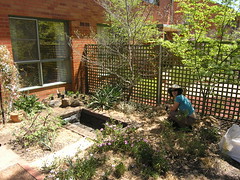
Last week I visited my friend's community garden plot with my 2 year old daughter. My friend also has a 2 year old - in fact we met in our mums and bubs group!

IMG_1644The plot is great and my friend is just getting started; mulching, composting and planting some winter broad beans and peas. Her son is also helping out and has his own little section of the plot. As we planted and raked, we talked about meeting others at the community garden and the space itself having lots of potential to set up small groups and workshops - especially a kids space!
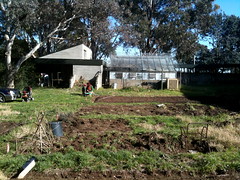
IMG_1645We asked ourselves, what about a community garden playgroup to bring kids and parents together? There's such a thing elsewhere, like Macedon for example,

Some of us have small children who now, after three years of going to ‘veggie club’, know each other and really look forward to gardening. My four year old is so keen if I mention I am going to do some gardening he gets very excited.
Also, the Braybrook Community Gardens and Playgroup Victoria run a permaculture set up too, which looks awesome!

I did a bit of a search for such things around Canberra but so far, I can't find anything online. Is there such a thing? Does anyone know of a community garden space that playgroups may use or parent groups use as a meeting place? We'd love to hear about your set up if so!

There's been some great moves in setting up kitchen gardens as part of the curriculum in primary schools - Stephanie Alexander's program is very popular, for example. But what of younger kids and their parents?

Wouldn't it be great to hook in to both a parents group AND a shared gardening experience?

Sunday, 9 March 2008

Garden layout and design: some revisions

We posted about our garden design back in early October, adding our new garden beds. From recent posts and photos you can see we're well underway getting the backyard into shape!


This second diagram shows the worm farm is no longer under the bay tree - Simon moved it under the patio eaves. The worms are going fabulously, so they must like the change! Also, we've potted a lemon tree into a half wine barrel, which is opposite the path from the passionfruit. It's the Meyer variety, said to do well in Canberra.

The area between beds 3/4 and bed 5 is still up for discussion - we're not sure (apart form moving the clothesline, as per dotted black line) as to what we'll do there. We were thinking of using some decking on the ground in a pattern perhaps, but could also plant or add another small bed. Currently it's a combination of (slightly pathetic) grass to the right and gravel on the left. There's paving at the base of the diagram too. We had planned to have no grass, but with recent rains the little patch has come back. We have even contemplated fake turf!

Still, we're looking at an overall "landscaped" (loosely speaking) solution to really turn the space into a user-friendly area. Any ideas welcome!

Sunday, 28 October 2007

Building a garden pond

We've finally finished our pond. It was a bit of work, but we reckon it's worth it, as it now gives the garden a different look and feel (even more so when we actually top it up with water!).

We've been looking into getting some native pond plants and ways to attract frogs too.

First, you must create the ideal habitat for frogs. From the slideshow here of our pond-making efforts, you can see the pond's location. It's in part shade and is shaded from the afternoon sun by the house (which is great in summer and hopefully will lessen the loss of water through evaporation), and using plants and the established trees we hope the microclimate will be conducive for frogs!

What's a microclimate? Basically, it's an area which exhibits a highly localised climate that is different to the general climate of an area. It can be as small as a few feet or as large as a few acres. We're hoping our pond will help to keep the area surrounding it cooler and more humid than areas further away. We've got a jasmine climbing on a frame nearby, a range of native plants, including lilies (a native pale vanilla lily), grasses and native violets; plus, some orchids, daphne, grevillea, and japanese maples. With the side of the house (brick) together with the lattice fence, the area is contained and protected from wind. The eaves also help protect plants from winter frosts. When creating microclimates it's good to think about

  • temperature control
  • patterns of light and shade
  • humidity
  • airflow
...as Carol from garden guides has.

What about maintaining your pond? We had a look at the ACT govt legislation website for details relating to ponds and water restrictions. Here's a snippet from the table of info they provide on the site (from left to right, staged restrictions apply up to level 5. We are currently on level 3 water restrictions):

  1. Private Ponds and Garden
    Fountains
Fountains to be switched Off unless they re-cycle water.

Ponds may be topped up by hand held hose or bucket

Fountains to be switched Off

Ponds may be topped up by hand held hose or bucket

Ponds that support fish or birds may be topped up by bucket directly filled from a tap but not a hose Ponds that support fish or birds may be topped up by bucket directly filled from a tap but not a hose Ponds that support fish or birds may be topped up by bucket directly filled from a tap but not a hose
Source: WATER RESTRICTION SCHEME APPROVAL 2002 - Utilities (Water Restrictions) Regulations 2002: Part 2, s 5: Approved water restriction scheme.

Sydney Water also have some tips on garden design for optimum water-saving, including the use of microclimates.

Additionally, installing a rainwater tank would mean you can top your pond up with rainwater rather than mains water. We're researching water tanks at present to see what will work in our location, to achieve optimum rain capturing and usage!

We'll post more on that later. For now, we're going tadpoling!