Sunday, 30 September 2007

Spring cleaning and mulch mulch more

We have a long weekend this weekend (hooray), so have been making the most of it out in the garden (despite the wind).

We took a drive down to Queanbeyan today to the Wholesale Sleeper Company and ordered 20 sleepers (A grade, well-priced), 2 x half wine barrels and 4 x bales of sugar cane mulch. We brought back 6 bags of potting mix with us too!

Do you get the feeling Spring is in the air? :o)

Remember this diagram? Well, we are about to dismantle our current backyard and put in garden beds made of sleepers. We'll start with beds 1 and 2, plus the worm farm area and the small area between the worms and the passionfruit. Currently this is grassed, so we're planning on putting a bed there -- it gets all day sun and we think perhaps there's a pipe below that keeps things moist(ish), as the grass is always green!

It's definitiely warming up. We put some strawberries in around the plum trees (Red Gauntlet variety) to see how they'll go. Companion Planting says that the strawberries act as 'an alterative host for a parasitic insect that preys on oriental fruit moths, a pest of peach trees' (1995, p.146), so we thought we'd see how they went with plums too. Borage is said to assist the growth of strawberries too, when interplanted.


We then drove a little further to Bungendore to the antique-recycling place there, and picked up an art deco(ish) style screen door on which to hang our jasmine - it's just taken off since the weather's warmed up! It sits next to our half-finished pond in the front garden, by the loungeroom window. Adds some height and perspective to the garden too. I'll pop a pic up soon!

Reference:

McClure, S. & Roth, S. (1995) Companion Planting. Lothian Books: Melbourne.


Tuesday, 11 September 2007

Springing into spring with broccoli

We've just got back from a two-week holiday overseas in the US, and were so pleased to see the garden still in tact and progressing well (somewhat slowly due to the cold)...

We were pleasantly surprised to see our broccoli doing well and were able to cut two heads for dinner!

The caulies however seemed to have fed the local possums - but I'm thinking in true companion planting style this benefitted the broccoli no end! :)

The rocket, coriander and parsley have had a burst of growth too, and the dwarf broad beans have copious flower buds (rubs hands with glee)! We have some red onions in too and have been thinning them to use as spring onions before they form their bulbs - love a plant that multi-tasks! :o)

Nice to have had a bit of rain too in the last couple of days - let's hope there's more to come.

Roll on spring, so far so good (and with very little insect damage to boot)!

Sunday, 5 August 2007

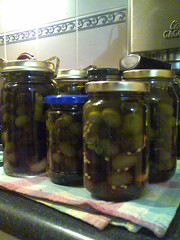
Curing olives

A colleague of Simon's had picked a heap of olives (from some trees that are over 70 years old), then had no time to cure them, so we took up the challenge to do so!

We had two recipes to try. I had tried curing olives a few years ago when we were still living in WA. I used a curing recipe from Stephanie Alexander's Cook's Companion (1st edition, p.631 if you have a copy). It worked OK, and used less salt than the one we recently tried, which is by Andrew Cope (who I think is linked to the Richmond Hill Cafe and Larder). It goes something like this:

  1. dissolve 1 cup salt in 3 litres of water in a large jar or bucket (not steel or aluminium)
  2. slit each olive lengthways to the stone and toss into the salted water
  3. replace the salt liquid everyday for 1 week, then once a week for the next 3 weeks, or until the bitter taste of the olives is gone
  4. sterilise some jars (with a good seal)...then this is where we changed the recipe...
  5. you can either store the olives in a salt wter brine with a layer of olive oil on top
  6. if you want to use the brine: mix 1/2 cup salt with 3 litres water, bring to the boil then cool before using...
  7. otherwise, we used a 50-50 mix of red wine vinegar (good quality) and an extra virgin olive oil with a mix of herbs and spices, such a lemongrass, chilli, coriander seeds, bay leaves, garlic gloves, oregano (dried/fresh) and thyme. Mix to your preference.
  8. We then let the olives sit for about 6 weeks before trying them.

A couple of 'learnings'...

We started with a mix of green and black olives. Black olives are simply ripened green olives and have a softer form. On reflection we would separate the olives which means the black ones wouldn't need as long to cure (they can become quite mushy otherwise).

Also, we probably didn't use the best olive oil for the jars and come tasting time, it really showed. The olives themselves were divine, and the red wine vinegar worked a treat, but the olive oil we used let the team down!

A work colleague asked me, 'aren't you worried about the amount of water used?' The answer is yes. What could be done with the salty water, other than throw it away? We could revert back to Stephanie's recipe were the salt is not introduced to the curing process until close to bottling, then you can re-use the water on your garden for example.

Anyway, we're always learning! here are some other curing webpages that might be of interest if you want to give olive curing a go yourself.

http://www.oliveoilsource.com/olive_recipes_.htm

http://www.wikihow.com/Cure-Olives (good alternatives if you're concerned about disposing of salt water)

And, if you've had success with curing olives, we'd love to hear from you!

Friday, 3 August 2007

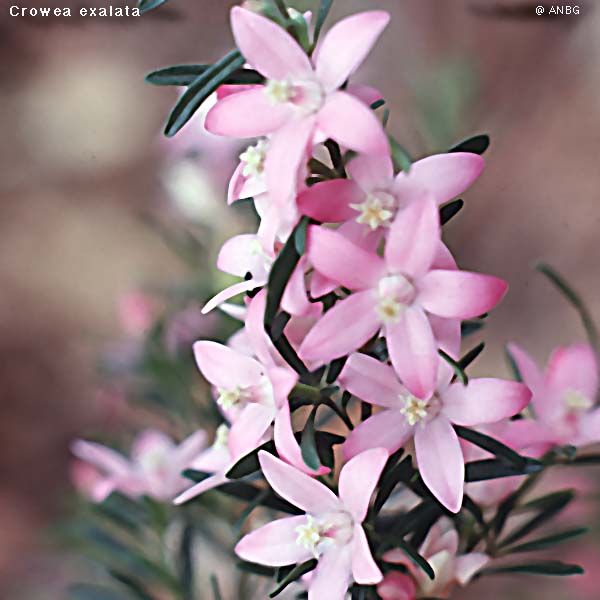
Mystery pink native solved!!

The small Crowea or Waxflower (Crowea exalata) is a native shrub of Victoria, related to the Boronias, and valued for the quality and quantity of its flowers. One of its brightest displays comes when most welcome, during autumn and winter. It is frost hardy and suited to cool and moist rather than hot conditions. Plants have been lost at about five years old following droughts and drying winds, though a well-watered and trimmed plant may be kept for years.

Crowea exalata - Growing Native Plants

I must thank my work colleague Lucy for her super-sleuth efforts on this one! Thank you Lucy :)

Our mystery pink flowering native is a Crowea exalata by the looks. The Australian National Botanic Gardens website provides a decent descriptionand a picture that confirms it all.

It has continued to flower throughout winter, frost and all. it certainly makes a lovely coloured centre-piece in an otherwise grey and wintery garden!distribution map

photo

images from angb (2003)

technorati tags:, , , , ,

Blogged with Flock

Sunday, 24 June 2007

Setting up a grey water system on the cheap

Post note: After using this system for about a month now, we realised we hadn't added a lint catcher of filter, so have stretched a piece of flywire across the top, held on with the lid. Simon also drilled out the small filter on the tap itself, which allows for greater flow-through of water.

Canberra is switching to stage 4 water restrictions sometime in July/August, which means NO outdoor watering (i.e. using potable water). ActewAGL also have a waste water treatment program to help manage our decreasing potable water levels.

We love our garden, like many other Canberrans, and while we generally use our washing (grey) water, sometimes when we wash we don't need to water the garden then and there (particularly now in the winter months). According to ACT Health, an average household can generate up to 528 litres of grey water everyday - crikey! Makes you want to reuse it, just to make it really worth it! :o) So, reusing our washing water (approx 120 litres a wash) is a pretty good start!

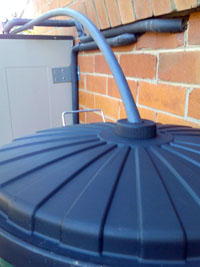
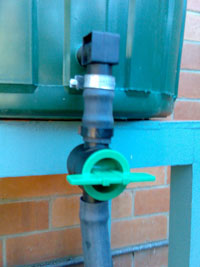
So today, we put together a cheap grey water system, made up of a 75 litre garbage bin (we have a small-ish washer), with a clip-on lid, outlet, garden tap and 13mm hose. We didn't want to spend up big on a complete system (being fairly recent home owners and all!), and wanted something that could collect washing water, yet allow us to water at another time as the garden needed it. We have an existing hose running from the machine out to the garden which we move about to soak plants.

The system goes together like this:

1. The hose runs from the washing machine outlet hose to the top of the "tank" (75 litre garbage bin).


2. A hole in the top (i.e. bin lid) allows any air to escape as the "tank" fills. The hose is set at top of the "tank", to avoid any siphon-effect, so that water does not get sucked back into the machine.


3. An outlet with a tap is fitted at the base of the "tank", to allow water to be used (via a gravity-feed method) when required. This will hopefully take the pressure of the washing machine pump too (fingers crossed).
**Note: ACT Health guidelines on using grey water strongly recommend you dispose of unused grey water after 24 hours via your sewage system - you need approval to store grey water any longer than 24 hours (it's a good read actually, states how to set up and manage your grey water use and explains the affects possible of grey water on your garden too).

We have set the system up just above our sewage drain outlet and can run unused water directly into the sewage system when necessary.


4. To use the grey water, we can either attach a hose that runs out into the garden, or use a watering can, depending on what requires a little watery lovin'! The good thing is that the system is pretty much a closed one, making it relatively safe (in terms of storing it at least).

Here's a quick slideshow of the parts that came together to make our cheap grey water system.

When I say the system is "cheap", the whole lot cost less than $A40. We had existing hose (about 15 metres or so) and used some silicon to seal the outlet at the base of the bin. All parts were found from our local hardware store too. It took less than an hour to set up the system itself and we will allow 48 hours for the silicon to set (especially so it doesn't contaminate the water and thus our lovely vegies and plants!). We could get a bigger bin, but given the time limit on storing grey water, it's likely 75 litres would suffice.

Eventually, we would love to have a fully integrated grey water system, where we could reuse the water for flushing toilets, as well as for watering the garden. This, combined with a rain water tank, would really reduce our water usage!

We'd love to hear how you're coping with water shortages and restrictions - what projects have you done to conserve water in your home? What do you think of our "cheap" grey water system?