We haven't forgotten about our gardening blog, just that life with a new baby is engulfing all aspects of day to day activities (plus, typing with one hand has its frustrations somewhat!)...anyway, we can update you on our recent backyard escapades!
With the birth of our beautiful daughter, new Dad, Simon, was blessed with 1 month's leave, in which time he (along with the help of the grandparents and my calls from the sidelines) managed to renovate-landscape our backyard! It really does look a treat and has opened up the spaces to be more user-friendly overall.
We have 4 main areas now,
1. Patio for relaxing, barbecuing, and reading the weekend newspaper :o) This is shaded by a big passionfruit vine that provides abundant fruit in summer...yum!
2. Vegie patch which is divided into 3 separate beds for crop rotation
3. Paved area (with clothesline) - we moved the clothesline to span a small grassed area that wasn't getting any use or attention, and paved this interspersing the pavers with native grasses, rushes, herbs and some native groundcovers to give some further visual interest

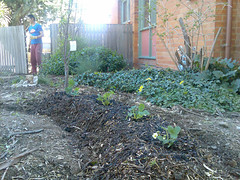
4. Fenceline garden bed with blueberry hedge - this long bed sits partly under a large native conifer that makes the soil acidic and somewhat water repellent, so we built up the bed with compost, manure and mulch, stabilising it with sleepers, and then planted 3 blueberry shrubs so they'll grow into a hedge. Underneath we can grow smaller plants like herbs, lettuces and some crawling vegies such as pumpkins, zucchini, and so on.
Turning this bed into a usable garden space has also opened up the graveled area between it and the paved area, which we can now use for our tai chi exercises! We can also put an outdoor setting here under the pine to make the most of those lazy sunny days in spring and autumn, as well as summer.
It's great to have the time and space to think about how we could make proper use of these spaces in our backyard, so we can get the most out of it depending on what activity we'd like to do in the day, whether it be gardening, tai chi, reading a book in the sun, or treating friends to a barbie lunch!
Monday, 22 September 2008
Springtime and spring cleaning in the backyard


Sunday, 11 May 2008
Pruning and preparing plum trees
As Autumn settles in, we've been doing a bit of clean-up of our vegies and native front garden. In addition, we've been working out preparations for the orchard trees, especially our two Japanese plums, Santa Rosa and Mariposa. I've been sifting through the web and our companion planting book for info on pruning times and procedures and fertilising. There's a mish-mash of info around, so I've attempted to pull some info together as a result. You can also jump into forums like Daly's Fruit Trees for further help from 'experienced others'.
Santa Rosa and Mariposa varieties
These two Japanese varieties are fairly hardy and can grow in most climates, as with the European varieties. They are said to respond well to 'low chill', which makes them ideal for more milder Winters. 'Low chill' means that they can set buds without requiring a long winter chill (European varieties on the other hand need a long chill time to set their buds). In Canberra the frosts provide the chill, but sometimes the winter itself may not be a long one, so we're confident the plums will do well here.
We planted the two plums in June of last year and they had set quite a few buds in the spring the same year, which was a great sign!
The Santa Rosa makes a good pollinator for other varieties especially the blood plums like the Mariposa. It will also self-fertilise to produce a decent crop on its own (according to other sources). Note that European and Japanese varieties will not cross-pollinate, so choose your trees carefully!
Pruning plum trees
Pruning occurs in the Winter, or as the trees lose their leaves. If you have frosty winters like we do in Canberra, then mid-late Autumn to early Winter is a good idea so the wood heals before the hard frosts hit. The idea behind pruning is to reduce the amount of unproductive wood, as the fruit sets along the mature wood. You can prune up to one third of the tree and maintain the tree to a height of around 2.5 metres, making it easier to pick the fruit and protect fruit from birds and possums. Gardening Australia have pruning tips here.
Our trees are only 12 months old, so we may not need to prune one-third, but more likely we can prune any of the early leading branches and laterals, so that the tree takes on a nice shape as it matures and branches don't cross over themselves.
Fertilising plum trees
In terms of stone fruit, Plum trees are probably the most tolerant with clay soils, which makes them more suited to Canberra's environment. To help, you can plant your trees in a raised position to ensure good drainage, or at least add some gypsum to your soil preparation when planting the trees.
An organic all-purpose compost and some blood and bone at budding stage will keep your trees healthy and provide nutrients as the fruit sets. Companion plants such a nasturtiums and lavender will attract bees to help pollinate the buds too. We also apply some sugarcane mulch around the base which provides protection from the frosts and also helps to keep the soil from drying out too much in the summer.
You can use a spray of copper oxychloride if your trees do get hit with diseases like shot hole or leaf curl. Don Burke and Gardening Australia have further tips on spraying fruit trees.
So, we're hoping for another healthy show of buds this year, maybe even a couple of fruit too! :o)
Sunday, 9 March 2008
Garden layout and design: some revisions
We posted about our garden design back in early October, adding our new garden beds. From recent posts and photos you can see we're well underway getting the backyard into shape!

 This second diagram shows the worm farm is no longer under the bay tree - Simon moved it under the patio eaves. The worms are going fabulously, so they must like the change! Also, we've potted a lemon tree into a half wine barrel, which is opposite the path from the passionfruit. It's the Meyer variety, said to do well in Canberra.
The area between beds 3/4 and bed 5 is still up for discussion - we're not sure (apart form moving the clothesline, as per dotted black line) as to what we'll do there. We were thinking of using some decking on the ground in a pattern perhaps, but could also plant or add another small bed. Currently it's a combination of (slightly pathetic) grass to the right and gravel on the left. There's paving at the base of the diagram too. We had planned to have no grass, but with recent rains the little patch has come back. We have even contemplated fake turf!
Still, we're looking at an overall "landscaped" (loosely speaking) solution to really turn the space into a user-friendly area. Any ideas welcome!
Saturday, 23 February 2008
Fernery and pond

We bought a tree fern last weekend and have put it near the lattice (I'm sure you can spot it at the back there). This one was harvested from Victoria and is about 2 feet tall (when measuring the core).
I'm wondering if others in Canberra have set up tree ferns too - what success have you had? Have they been fairly self-managing? Do they require a lot of attention in particular? We also bought a native fern (just to the left of the tree fern in the photo here), which is in fact a water fern by name, but said to be a hardy plant.
So, we'll see how our semi-wet/semi-dry fernery goes over the next month as we move into Autumn and Winter.
Summertime: corn and snake beans

Our small lot of corn have taken off with the cobs almost ready to pick. We planted some snake beans beneeath them and they've started climbing over the corn and shooting lovely purple flowers, ready to fruit as well.
Our tomatoes are like a jungle - cherry, roma and everything else in between! There's potato plants among them - if we could only just find them.
And our pièce de résistance has been the fruiting of our old passionfruit vine which covers our back patio frame. Hoorah! Lots of fruit dropping off, presenting themselves graciously to us and they are lush and perfumey to eat too.
A bit of TLC and you really (literally) reap the rewards!


 Save to Delicious